What Are the 2026 Top Types of Grow Lights Globally?
What Are the 2026 Top Types of Grow Lights Globally? This question matters to indoor growers, commercial farms, researchers, and home gardeners. Lighting affects plant shape, flowering, energy use, temperature, and operating costs. The strongest choice is rarely based on brightness alone.
LED grow lights lead global discussions because they offer adjustable spectra, directional output, and lower heat near the canopy. Modern LED fixtures can support seedlings, leafy greens, herbs, and flowering crops. High-pressure sodium lights still serve large facilities that value strong flowering performance and familiar equipment. Ceramic metal halide remains useful where balanced light and natural-looking colors matter. Fluorescent systems continue to suit propagation shelves and small spaces, although their efficiency is increasingly limited.
Not every ranking is reliable. A fixture may look powerful in advertising but perform poorly across a full growing area. Independent measurements, photosynthetic photon efficacy, PPFD mapping, thermal testing, and warranty terms deserve careful attention. Certification and electrical safety also matter across different countries. Real experience shows that installation height, reflective surfaces, ventilation, crop distance, and local electricity prices can change the final result.
The global market is moving toward intelligent LED systems, tunable spectra, wireless controls, and sensor-based dimming. Still, technology does not replace good horticultural judgment. A lower-cost fixture may be adequate for herbs, while dense flowering crops need stronger uniformity and better heat management. Some recommendations remain uncertain because manufacturers publish different testing methods. This guide compares the leading grow lights through practical performance, verified specifications, crop suitability, and long-term value. The conclusions may need revision as efficiency standards and lighting research continue to develop.
Global Grow-Light Types in 2026: LED, HPS, Fluorescent, and Induction
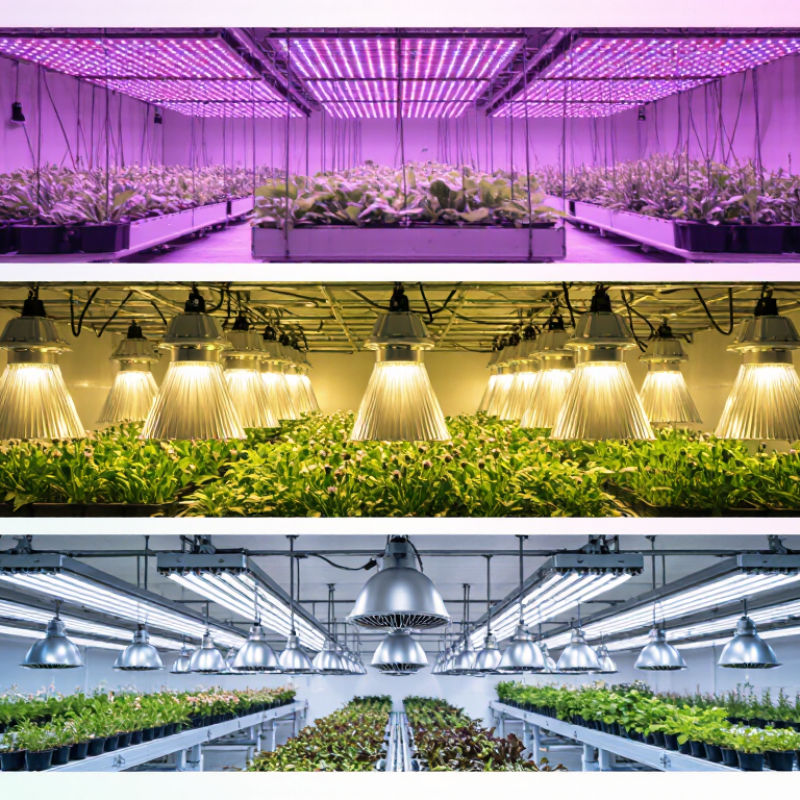
In 2026, LED remains the leading global grow-light type. Grand View Research’s 2024 report projects the horticulture-lighting market to expand at a 19.7% CAGR through 2030. LEDs support adjustable spectra, dimming, and lower heat output. Modern fixtures can exceed 2.5 micromoles per joule, although real performance depends on cooling and installation. HPS still serves large flowering rooms because it delivers strong canopy penetration and proven reliability. However, its radiant heat can increase cooling demand. Fluorescent lamps remain practical for seedlings, cuttings, and small shelves. Induction lights offer long service life, but limited availability keeps them a niche option.
Tips: Compare PPFD maps, not wattage alone. Measure light at canopy height. Check fixture efficacy, spectrum, heat load, and replacement costs together. A spreadsheet can mislead.
The U.S. Department of Energy’s Solid-State Lighting reports identify efficacy, thermal management, and controllability as major development priorities. Those points matter in commercial trials. LEDs usually win when electricity, labor, and climate control are measured across several growing cycles. HPS may still compete where electricity is inexpensive or existing ventilation is strong. Fluorescent and induction systems can make sense in specialized spaces, despite weaker market momentum. My field experience suggests that “best” is rarely universal. Crop height, photoperiod, ceiling clearance, and local power prices change the answer. The ranking is useful, but imperfect.
What Are the 2026 Top Types of Grow Lights Globally?
LED systems lead modern horticultural lighting because they typically provide the highest photon efficacy and lower heat output than legacy technologies. HPS remains widely used in large-scale facilities, while fluorescent and induction systems are more common in specialized or legacy installations.
Values show representative system photon-efficacy levels commonly reported for commercial grow-light technologies in 2026, measured in micromoles per joule (µmol/J). Actual performance varies by fixture design, operating conditions, and application.
HPS Lighting: 1.7–2.1 μmol/J Performance for High-Intensity Crops
HPS Lighting: 1.7–2.1 μmol/J Performance for High-Intensity Crops
High-pressure sodium lighting remains relevant for high-intensity horticultural production. Industry engineering data commonly places modern HPS systems between 1.7 and 2.1 μmol/J. Actual results depend on the lamp, ballast, reflector, and operating temperature. Small details matter.
The U.S. Department of Energy’s 2023 Solid-State Lighting R&D Opportunities report identifies higher-efficiency solid-state systems as a major industry direction. However, HPS still delivers strong canopy penetration and stable output across large growing areas. In practical installations, its radiant heat can reduce winter heating demand, but it may increase cooling loads during warm periods. I have seen this trade-off affect room balance more than expected.
A 2024 controlled-environment agriculture market review from Agrilyst and related industry surveys shows that electricity and climate control remain major operating costs. Therefore, judging HPS only by μmol/J is incomplete. Measure wall-plug power, delivered PPFD, fixture spacing, and cooling energy together. Use calibrated sensors at canopy height. Keep records.
HPS also has a familiar operating profile. Replacement cycles, warm-up time, and spectrum limitations require planning. Its red-heavy spectrum can support flowering crops, yet crop response varies by cultivar and photoperiod. The 1.7–2.1 μmol/J range is useful, not absolute. Field measurements can disagree. That is where careful verification matters.
What Are the 2026 Top Types of Grow Lights Globally?
HPS Lighting: 1.7–2.1 μmol/J Performance for High-Intensity Crops
| Grow Light Type |
Typical Fixture Efficacy |
Useful Photons per Joule |
Typical Service Life |
Spectrum Characteristics |
Best-Fit Crops and Uses |
Heat and Operating Considerations |
2026 Market Position |
| Horticultural LED |
2.3–3.5 μmol/J |
High |
35,000–100,000 hours |
Available in broad-spectrum, white, red-enhanced, and far-red configurations; spectrum can be precisely tuned. |
Indoor farms, vertical farms, propagation, leafy greens, herbs, flowering crops, and supplemental greenhouse lighting. |
Lower radiant heat than discharge lamps, but heat must be removed from the diode and driver. Dimming and network control are widely available. |
Leading efficiency choice |
| High-Pressure Sodium (HPS) |
1.7–2.1 μmol/J |
High |
12,000–24,000 hours |
Strong yellow, orange, and red output with limited blue light; useful for flowering and high-intensity crop production. |
Large greenhouses, high-intensity flowering crops, commercial supplemental lighting, and facilities with existing HPS infrastructure. |
High radiant and convective heat load; requires ventilation or cooling. Lamp output and spectrum gradually decline with age. |
Established high-intensity option |
| Ceramic Metal Halide (CMH/CDM) |
1.4–1.9 μmol/J |
Medium to high |
12,000–20,000 hours |
Relatively balanced white spectrum with more blue energy than HPS; good color rendering for crop inspection. |
Greenhouses, growth rooms, mother plants, vegetative crops, and applications requiring a more natural-looking spectrum. |
Produces substantial heat and requires compatible ballasts and reflectors. Lamp replacement is needed more often than with LED systems. |
Specialized discharge technology |
| Fluorescent T5/T8 |
0.8–1.7 μmol/J |
Low to medium |
10,000–20,000 hours |
Cool-white, warm-white, and plant-oriented lamp spectra are available; broad, diffuse light is suitable for young plants. |
Seedlings, cuttings, clones, herbs, houseplants, and low-canopy propagation benches. |
Moderate heat and relatively low penetration into dense canopies. Output decreases as tubes age. |
Propagation and low-canopy use |
| Induction Lighting |
0.8–1.5 μmol/J |
Low to medium |
60,000–100,000 hours |
Broad-spectrum output is possible, but spectral flexibility is generally lower than modern LED systems. |
Long-life installations, specialty greenhouse projects, and retrofit applications where relamping access is difficult. |
Lower relamping frequency, but fixtures can be bulky and less efficient than current horticultural LEDs. |
Niche long-life option |
| Incandescent / Halogen |
0.3–0.7 μmol/J |
Very low |
1,000–2,000 hours |
Strongly weighted toward red and far-red wavelengths with very little blue light. |
Limited experimental photoperiod control or supplemental warmth; generally unsuitable for commercial crop production. |
Very high heat output and high electricity consumption. Poor photon efficiency makes it uneconomical for routine crop lighting. |
Legacy and limited use |
Full-Spectrum LEDs and Crop-Specific Spectral Strategies in 2026
Full-Spectrum LEDs and Crop-Specific Spectral Strategies in 2026
Full-spectrum LED systems remain a leading grow-light type in 2026. They produce balanced wavelengths across the visible range. This supports leafy growth, flowering, and visual crop inspection. The 2024 Horticulture Lighting Market report by MarketsandMarkets projected the sector to grow from about USD 6.8 billion in 2024 to USD 11.8 billion by 2029. Efficiency is driving that expansion. Yet, market growth does not prove that one spectrum suits every crop.
Crop-specific lighting is becoming more precise. Blue light can encourage compact growth and stronger leaf formation. Red light often supports flowering and biomass production. Far-red light may influence flowering time and plant architecture. However, its response depends on cultivar, temperature, photoperiod, and daily light integral. Too much far-red can stretch some plants. The result may be disappointing.
Professional growers now track PPFD and DLI instead of judging brightness by eye. The U.S. Department of Energy has identified controllability and improved photon efficiency as major advantages of solid-state horticultural lighting. The DesignLights Consortium’s horticultural guidance also emphasizes tested performance, spectral data, and safety documentation. These details matter in a greenhouse. They matter more in a small indoor room. I have seen “full-spectrum” used as a complete recommendation. That assumption is too neat. A better 2026 strategy combines efficient LEDs with adjustable spectra, crop trials, and measured plant responses. No preset can replace observation.
Comparing PPFD, DLI, Lifespan, Heat, and Energy Costs by Light Type
What Are the 2026 Top Types of Grow Lights Globally?
In 2026, full-spectrum LED fixtures lead most indoor growing comparisons. They commonly deliver 2.5–3.5 µmol/J, producing strong PPFD with lower electricity use. Their rated lifespan often reaches 50,000–100,000 hours. Heat remains manageable, but not absent. Every watt eventually becomes heat indoors. A poorly ventilated room can still overheat.
High-pressure sodium lights remain powerful and familiar. They can produce excellent PPFD, but usually consume more energy per photon. Their lifespan is commonly 10,000–24,000 hours, with noticeable output decline over time.
Ceramic metal halide offers balanced spectrum and moderate PPFD. However, it usually creates more heat than LED. Fluorescent tubes suit seedlings and low-light areas, but their lower efficiency raises long-term operating costs.
DLI depends on PPFD and photoperiod, not fixture type alone. Use this formula:
DLI = PPFD × hours × 0.0036
A 600 PPFD setting for 16 hours gives about 34.6 mol/m²/day.
Tips:
Measure PPFD at canopy height, not on the product box. Record room temperature, power draw, and DLI for one week. Compare electricity costs using your local tariff. LED often wins, but the cheapest fixture is not always the cheapest system. Driver quality, cooling, maintenance, and replacement parts can change the result. My practical concern is simple: light maps are rarely perfect. Recheck them after plants grow taller.