Choosing LED fixtures for global projects in 2026 requires more than comparing wattage and purchase prices. Project teams must evaluate photometric performance, climate resistance, controls, maintenance access, and regional installation practices. A fixture that performs well in a dry warehouse may fail near a humid coastline. Dust, vibration, voltage variation, and extreme temperatures can quietly increase operating costs. These details matter.
Experienced lighting professionals begin with the project’s purpose. Retail spaces may need accurate color rendering, while logistics facilities often prioritize uniform illumination and low maintenance. Healthcare, hospitality, and outdoor applications demand different safety and visual comfort considerations. LED fixtures should support reliable control systems, documented testing, and clear warranty terms. Certifications must be verified for the destination market, not assumed from a supplier’s brochure. That step is easy to overlook.
Global sourcing also requires practical communication. Confirm photometric files, driver compatibility, spare-part availability, and installation instructions before approving a design. Ask suppliers how products performed in comparable climates. Request samples when glare, beam spread, or finish quality could affect the result. A spreadsheet cannot reveal every field problem. Site experience still matters.
No choice is perfect.
The strongest decision balances energy efficiency, service life, compliance, appearance, and total ownership cost. Teams should record assumptions and review them with local engineers, contractors, and facility managers. Their feedback can expose risks that remote design teams miss. Even a well-researched specification may need adjustment after installation. In 2026, responsible selection means using current technology without treating every new feature as essential. Reliable performance remains more valuable than impressive claims.
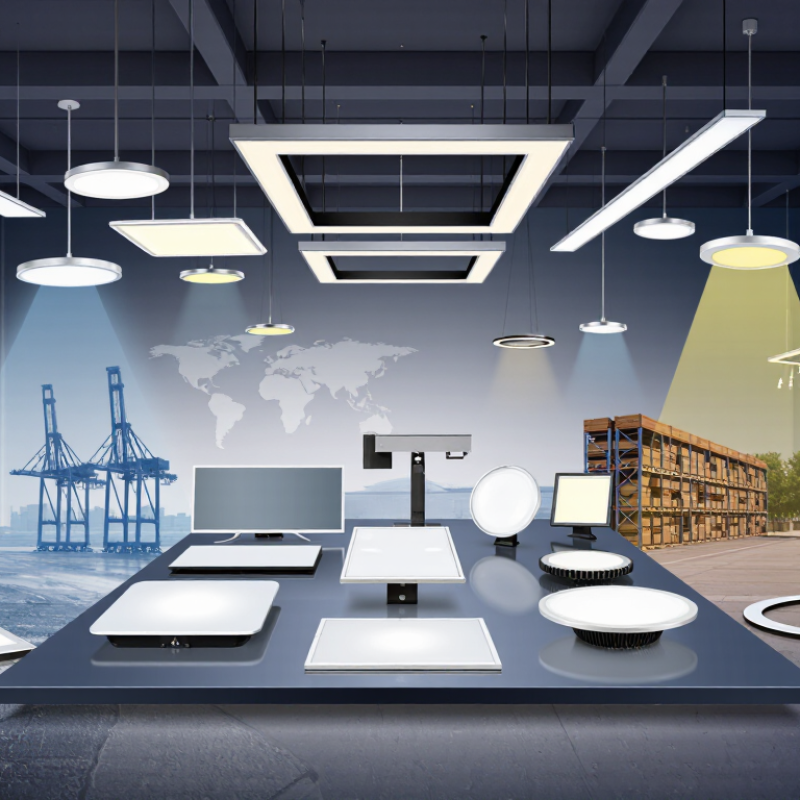
Before selecting LED fixtures for a global project, define the electrical load and lighting target. I begin with room dimensions, mounting height, operating hours, and control requirements. Then I calculate connected load, diversity, emergency capacity, and expected energy use. A spreadsheet can still lie. Confirm assumptions with site measurements and local electrical conditions.
Lux targets should match the activity, not simply the client’s preference. A warehouse aisle, hospital corridor, and office desk need different illumination levels. Model maintained lux, because dust, aging, and optical loss reduce real performance. Check uniformity as well. Bright spots and dark corners create complaints, even when average lux looks acceptable.
Set CCT according to visual comfort and the project’s cultural context. Neutral white often suits offices, while warmer light can support hospitality areas. Specify CRI at 80 or higher, then verify R9 when skin tones or merchandise matter. For 2026 projects, compare fixtures within a practical efficacy range of 100–200 lm/W. Higher efficacy is useful, but not automatically better. Glare, flicker, heat, beam angle, and driver reliability still affect results. I have seen impressive laboratory figures perform poorly after installation. Request photometric files, test reports, warranty terms, and sample fixtures before approval. Recheck the design after ceiling changes. That step is often missed.
For global projects in 2026, fixture selection starts with compliance, not lumen output. The IEA’s Energy Efficiency 2023 report estimates that lighting uses about 15% of global electricity. That makes efficient, compliant equipment a procurement issue, not merely a design preference. IEA also reports rapid LED adoption, but savings depend on controls, quality, and operating conditions. Check test reports against IEC 60598, including thermal safety, insulation, construction, and abnormal-operation testing. A beautiful photometric file proves little.
Build a country-specific compliance matrix. For Europe, verify CE marking, the Declaration of Conformity, EMC evidence, and RoHS substance controls. CE is a manufacturer’s conformity declaration, not an independent quality badge. For North American projects, confirm the required UL pathway and installation conditions. Check whether the exact fixture, driver, and mounting method are covered. EMC testing should address conducted and radiated disturbances, especially near medical, industrial, or wireless equipment. Small omissions become expensive.
IP ratings require physical interpretation. IP65 resists dust and water jets, but it does not guarantee chemical resistance, immersion, or long-term outdoor sealing. Match IEC 60529 test conditions with coastal spray, condensation, washdown, or construction dust. U.S. Department of Energy solid-state lighting reports repeatedly emphasize lifetime testing and thermal management. Claimed hours are not field certainty. Ask for current reports, traceable samples, and change-control records. I would question my own checklist: certificates can be genuine, yet outdated. Re-test after changing optics, drivers, housings, or suppliers.
For global projects in 2026, LED fixture selection should begin with measurable performance, not appearance. L70 indicates when an LED package reaches 70% of its initial light output. A higher rated lifetime can reduce relamping work in warehouses, offices, and transit areas. However, L70 is not the same as total fixture life. Thermal conditions, driver quality, dust, and operating hours also affect results. Ask for test data under realistic ambient temperatures.
Color consistency matters when fixtures are installed across large ceilings or long corridors. SDCM, or Standard Deviation of Colour Matching, measures visible color variation. A lower SDCM value usually creates a more uniform visual field. Three-step SDCM is often suitable for professional interiors, while tighter control may be needed for galleries, retail spaces, or medical environments. Check whether the stated value applies to initial production only. That detail is easy to miss.
Power factor should be at least 0.90, especially in projects with many fixtures operating together. A strong power factor helps reduce wasted current and supports more predictable electrical planning. Confirm the value at the project voltage, frequency, and expected load. Some products perform differently at partial dimming. Request independent reports, driver specifications, and samples before approval. A sample can reveal flicker, color shifts, or an awkward mounting detail. Specifications look precise. Site conditions are not.
For a global project in 2026, control selection deserves the same attention as lumen output. Electrical codes, labor skills, and network rules vary by country. Plan the control layer before fixture orders. Check voltage, frequency, cable routes, commissioning tools, and replacement access. A technically elegant system can fail when local technicians cannot service it.
DALI-2 suits projects needing digital addressing, scene control, energy data, and device feedback. It can support room-by-room adjustments, but commissioning requires careful labeling and trained personnel.
0–10 V remains practical for simple dimming zones and familiar maintenance routines. Its wiring is straightforward, yet it offers less detailed feedback. Keep control cables separated where local rules require it.
Sensors need a physical review, not only a software setting. A ceiling sensor near an air vent may detect movement poorly. Daylight sensors can also misread bright floors or reflective walls. Test coverage at different times.
Smart grid links should use a secure gateway, clear permissions, and a local fallback mode. When communication fails, lights must not leave occupants in darkness. This point is easy to overlook. During design reviews, challenge every assumed network dependency. Some plans still treat cybersecurity and commissioning records as optional, which is a costly weakness.
Evaluating total cost means looking beyond the purchase invoice. In field projects, I compare fixture wattage, operating hours, local electricity prices, installation time, and replacement access. A 120-watt fixture may cost more initially, yet use less energy than an older 250-watt unit. The numbers shift. That difference becomes significant in warehouses running twelve hours daily.
A rated life of 50,000 to 100,000 hours can reduce relamping work, especially where ceilings exceed eight meters. However, rated life is not the same as guaranteed performance. Heat, dust, voltage variation, and frequent switching can shorten useful life. Check tested lumen maintenance, operating temperature, surge protection, and driver reliability. A fixture with stable output may prevent dark areas and extra lift rentals. That matters.
Maintenance planning should include labor rates in each country. Replacement access can be cheap in one region and expensive in another. Keep records. For every project, estimate annual energy savings and divide the added purchase cost by those savings. Then add cleaning, inspection, spare units, and disposal costs. Our early estimates were sometimes too optimistic because we ignored import delays and difficult access. A practical evaluation also reviews photometric data, installation instructions, warranty conditions, and local technical support. Energy efficiency is valuable, but dependable service usually protects the investment.